That Little Lump Might Be Nothing — Here's How to Tell
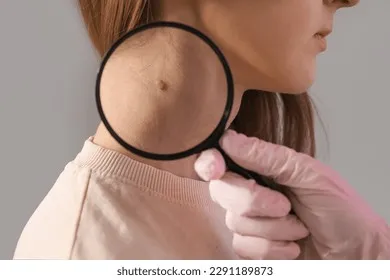
Photo: woman examining mole on skin with mirror close up, via www.shutterstock.com
You've Probably Got One Right Now
A mole on your shoulder. A skin tag under your bra strap. A tiny white bump that's been camped on your cheek since 2019. Most British adults are carrying around a small collection of skin growths, and most of them are completely harmless. The tricky part? Knowing which is which.
This isn't about scaremongering. It's about giving you a practical mental filing system, so you can sort the 'purely cosmetic' from the 'book a GP appointment' without losing sleep either way.
The Usual Suspects
Moles are clusters of pigment cells. They're usually brown or black, roundish, and relatively stable. Most people have between 10 and 40, and the majority never cause a problem.
Skin tags are soft, flesh-coloured flaps of skin that hang off on a little stalk. They love friction zones — neck, armpits, groin, under the bust. They're benign, common, and tend to multiply with age. Nothing sinister, just occasionally annoying when a necklace catches one.
Milia are those tiny white pearls, often around the eyes. They're trapped keratin, not spots, and they don't squeeze out no matter how much you try (please don't try). They typically clear on their own.
Seborrhoeic keratoses are waxy, stuck-on-looking growths that show up more as we get older. Harmless, though they can be mistaken for something worrisome — which is exactly why identification matters.
Warts are caused by a virus and are slightly contagious. Verrucas are their foot-dwelling cousins.
The NHS ABCDE Rule
When it comes to moles, the NHS advises watching for these five signs:
- Asymmetry — one half doesn't match the other
- Border — edges are blurred, jagged or ragged
- Colour — uneven shades, or multiple colours in one mole
- Diameter — larger than about 6mm (roughly the width of a pencil eraser)
- Evolving — changing in size, shape, colour, or behaviour (itching, bleeding, crusting)
One of these alone isn't automatically alarming, but any of them is a good reason to get a professional opinion. Take a photo with a ruler or coin for scale, date it, and compare in a month. Your phone's camera is genuinely one of the best skin-health tools you own.
Cosmetic Nuisance vs Medical Red Flag
Here's the honest division. Skin tags, milia and mature seborrhoeic keratoses are essentially cosmetic concerns — annoying, but not dangerous. Moles are the category that deserves ongoing vigilance, because melanoma can masquerade as an ordinary-looking mole.
See a GP promptly if a growth:
- Bleeds, weeps, or crusts without cause
- Changes quickly over weeks rather than years
- Looks dramatically different from your other moles (the 'ugly duckling' sign)
- Has been itchy or painful for no obvious reason
And if you're ever simply unsure? That's a valid reason too. UK GPs would far rather check a harmless mole than have a patient sit on a worrying one.
What About Removing Them?
Cosmetic blemishes like skin tags are often something people want gone for comfort or confidence reasons. Whatever route you consider — whether an at-home topical product or a clinical procedure — the same principle applies: know what you're treating first. A serum formulated for a skin tag has no business being applied to an unexamined mole.
The Bottom Line
Your skin is allowed to have character. Lumps, bumps and dots are normal. The goal isn't panic — it's familiarity. Learn your own skin's landscape, run the ABCDE check every couple of months (the first of the month is an easy habit), and treat anything new or changing as a conversation starter with your GP. Clearer skin starts with knowing what you're looking at.