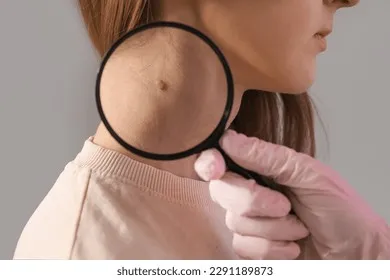
Spot Check: What's Really Living on Your Skin (And Why You Shouldn't Guess)
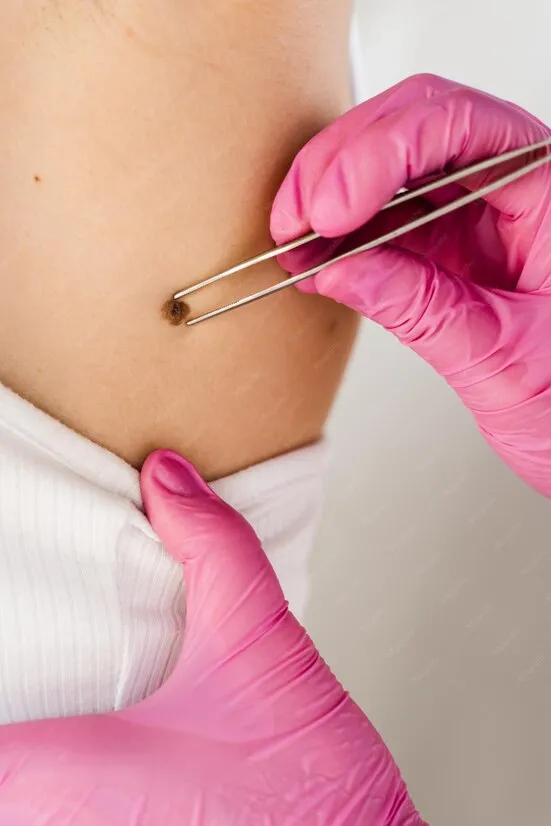
Photo: dermatologist examining moles on patient skin close up, via img.freepik.com
Most of us have a mental shortcut when we spot something new on our skin: if it's small and brown, it's a mole. If it dangles a bit, it's a tag. If it showed up after a summer in Benidorm, it's an age spot. Simple, right?
Except it isn't. And treating a guess as a diagnosis is where problems start.
The Usual Suspects
Let's run through the growths that most commonly send people to Dr Google at midnight.
Common moles are usually round or oval, evenly coloured (browns, blacks or flesh tones), and roughly symmetrical. Most of us carry between 10 and 40 of them, and they can slowly change over decades — that's normal.
Skin tags are soft, flesh-coloured flaps that hang off the skin on a tiny stalk. They love friction zones: the neck, armpits, under the bra strap, the groin. Genuinely harmless, occasionally annoying, and extremely common once you're past 40.
Age spots (doctors call them solar lentigines) are flat, tan-to-brown patches on sun-exposed areas — the backs of hands, forearms, face. They're the skin's receipt for years of UV exposure, which in Britain often means decades of 'it's not even sunny' denial.
Seborrheic keratoses are the great impersonators. Waxy, stuck-on looking, sometimes dark and bumpy — they can mimic melanoma and vice versa. Definitely one for a professional eye, not a phone camera and vibes.
Why Diagnosis Comes First — Every Time
Here's the bit that matters. A removal serum, cream or patch doesn't know what it's being applied to. It burns or dissolves whatever's there.
If that growth turns out to be something more serious — most importantly a melanoma — you haven't removed it. You've altered it, potentially masked it, and delayed a diagnosis where every week counts. Skin cancer caught early is very treatable; caught late, it's a different conversation entirely.
This is also why the NHS is firmly against at-home mole removal. Its guidance on moles is clear: any mole that changes shape, colour, size, or that bleeds, itches or crusts should be checked by a GP. Not treated at home. Checked.
Skin tags are the exception in terms of risk — but even then, self-treatment carries infection and scarring risks that far outweigh the £7 you'd spend on a serum.
When to Book That GP Appointment
Don't sit on it if you notice any of the following:
- A mole that looks different from its neighbours (the 'ugly duckling' sign)
- Asymmetry, ragged borders, multiple colours or a diameter beyond about 6mm
- Any lesion that bleeds, weeps, itches or won't heal
- A new growth after your 50th birthday
Your GP may examine it, use a dermatoscope, or refer you onward. In England you can also self-refer to some NHS dermatology services; in Scotland and Wales, speak to your GP practice first. Either way, it's free and it's fast compared to the alternative.
The Habit Worth Building: The Photo Spot Check
Here's a skincare routine that costs nothing and outperforms any product on the shelf: photograph your skin every three months.
Pick a consistent spot with good light. Snap your back, chest, arms, legs, face and scalp (a partner or a phone on a timer helps for the awkward angles). Date-stamp the photos and file them in a dedicated album.
Why it works: the human memory is hopeless at tracking slow change. That mole you've 'always had' might have grown 2mm in a year without you noticing. A photo library doesn't forget, and it gives your GP a genuine before-and-after if you ever do need an appointment — the useful kind of before-and-after, for once.
Where Corrector Serums Fit In
There's a place for topical skin correctors in a routine — mainly for cosmetic concerns like flat age spots or surface texture, once a professional has confirmed what you're dealing with. What there's no place for is DIY diagnosis. Knowing exactly what's on your skin isn't the boring step before the fun one. It is the treatment plan.
Clearer skin does start here — but it starts with certainty, not guesswork.