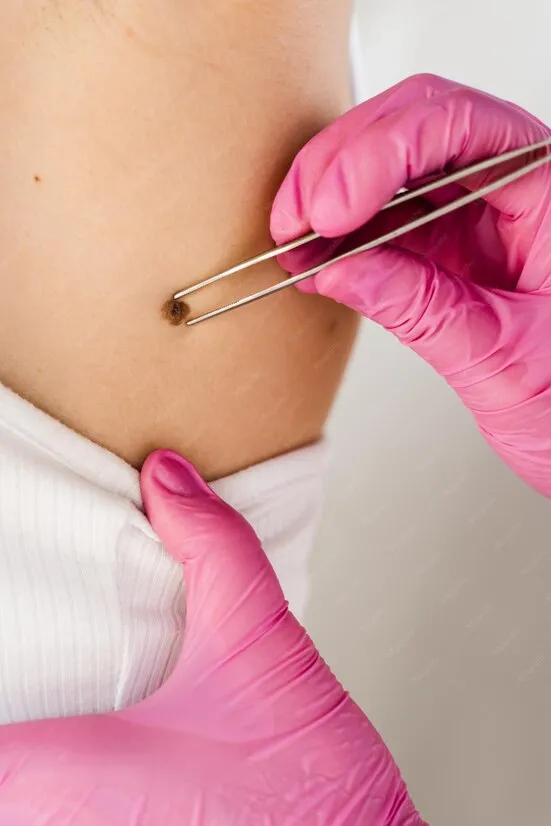
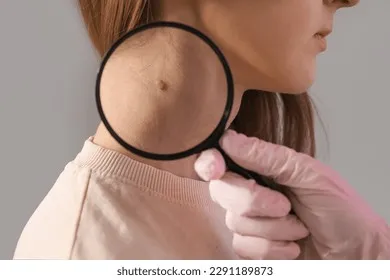
Dr Google Doesn't Do Follow-Ups: When Your Mole Needs a Human, Not a Search Bar
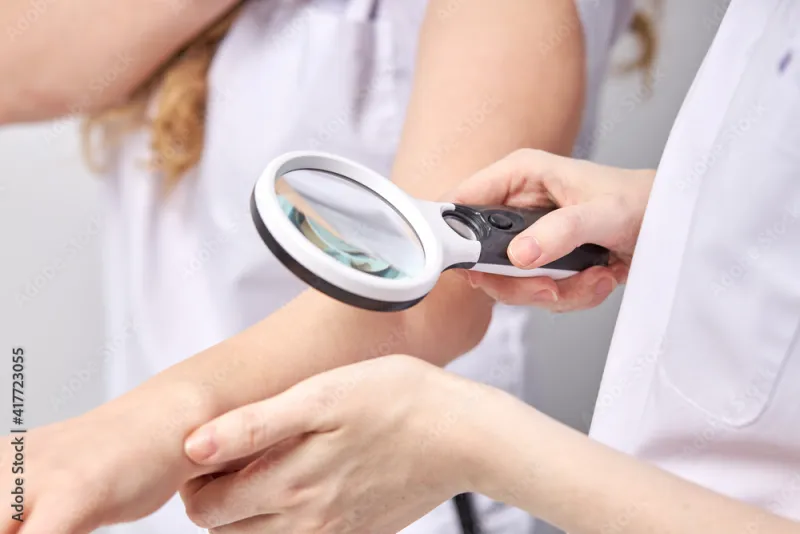
Photo: woman examining mole on skin with dermatologist magnifying glass UK clinic, via as1.ftcdn.net
There's a particular kind of modern ritual we all know: you notice a new mark on your shoulder in the bathroom mirror, take a slightly blurry photo on your phone, zoom in, and within ninety seconds you've convinced yourself of at least three possible outcomes — two of them alarming. Welcome to self-diagnosis culture, where the search bar has become the UK's most-visited dermatology clinic.
And look, we get it. Getting a GP appointment can feel like winning a small lottery. Waiting rooms are rammed, pharmacists are brilliant but stretched, and the internet is always open. But here's the thing the skincare industry doesn't always say out loud: no serum, app, or forum thread can tell you whether a mole is benign. Only a qualified professional can, and knowing when to stop scrolling and start dialling matters more than anything you'll find on this site or any other.
The Rise of the Armchair Dermatologist
UK shoppers have never been more skin-curious. Searches for mole-checking apps, at-home removal kits, and skin tag serums have climbed steadily over the past few years, driven partly by longer NHS waiting lists and partly by a beauty culture that treats every blemish as a problem to be solved by Tuesday.
The trouble is that skin doesn't read the same forums we do. A tag that looks identical to thousands of harmless ones can, in rare cases, be something else entirely. Dermatologists who work within the NHS routinely describe patients who spent months treating a lesion at home — with acids, freezing kits, or herbal pastes — before finally walking through the surgery door, by which point the diagnosis was harder and the treatment more involved.
What the ABCDE Rule Actually Tells You (and What It Doesn't)
You've probably seen the ABCDE checklist: watch for moles that are Asymmetrical, have an uneven Border, contain multiple Colours, are larger than about 6mm in Diameter, or are Evolving in size, shape, or sensation.
It's a genuinely useful bit of public health messaging — arguably the most useful thing on this list. But here's what it doesn't do: it doesn't clear a mole. A lesion can fail none of the ABCDE tests and still need review, and some melanomas don't follow the rulebook at all. The checklist is a prompt to get checked, not a certificate of good health. If you're using it to talk yourself out of a GP visit, you've misunderstood the assignment.
Five Times the Search Bar Loses to the Surgery
1. A mole that's changing. Any mole that's growing, darkening, bleeding, itching, or crusting needs a professional's eyes — full stop. No at-home product is designed for this, and using one delays proper assessment.
2. Anything on your face, eyelids, or genitals. Delicate skin, tricky anatomy, and a high margin for error. These are clinic jobs, not bathroom-shelf jobs.
3. A lesion that bleeds or won't heal. A spot that hasn't settled after a few weeks deserves more than a stronger exfoliant.
4. You're not sure what it is. This one's simple: uncertainty is itself a reason to see someone. Skin tags, seborrheic keratoses, warts, and moles can look remarkably similar to the untrained eye — and they respond to completely different treatments.
5. You're under 16, pregnant, or managing a condition that affects healing. Certain groups should always route skin concerns through a GP first, no exceptions.
Where Home Products Do Fit In
None of this means the bathroom shelf is redundant. Targeted serums have a legitimate role for cosmetic concerns — the odd skin tag on the neck, small benign bumps that a doctor has already confirmed are nothing sinister. The key phrase there is already confirmed.
Think of it like this: a GP or dermatologist is the surveyor; a correction serum is the decorator. You wouldn't repaint before you've had the damp checked. Once you know exactly what you're dealing with, a well-formulated product applied as directed is a reasonable, low-risk option for cosmetic improvements.
How to Actually Get Seen (Without the Drama)
If you're worried about a mole, you don't need to negotiate with an online triage quiz. In England, most practices let you submit a photo of a skin concern through online consultation tools, which a clinician reviews before deciding if you need to come in. In Scotland, Wales, and Northern Ireland, NHS 111 and your local practice remain the front door. Private mole clinics exist too — just check that any clinician you see is properly qualified and that they offer dermoscopy, not just a glance.
The Bottom Line
Self-diagnosis culture isn't going anywhere, and honestly, being curious about your own skin is no bad thing. But curiosity should end at the GP's door, not replace it. Use the internet to learn what's normal for your skin. Use the surgery to confirm it. And use the serum — if it's appropriate at all — only after you know exactly what you're treating.
Your skin keeps a lifetime of records. When something looks off, the person best qualified to read them still has a name, a degree, and a waiting room — not a search bar.